



The prompt management category just went through its first real shakeout. Since mid-2025, Humanloop wound down, Helicone was acquired and moved to maintenance mode, Promptfoo was acquired by OpenAI, and Vellum pivoted to a consumer AI assistant. Half of the "best prompt management tools" lists you'll find on Google today recommend software you can no longer safely adopt.
So this guide starts from a different question than most: which prompt management tools are not just good, but still being built - and how do they actually compare when you put the same workflow through each one?
What is prompt management?
Prompt management is the practice of treating prompts as versioned, testable production assets that live outside your codebase. A prompt management system stores every prompt template in a central registry with version history, release labels (like prod and staging), evaluations, and usage analytics - so your application fetches prompts at runtime instead of hard-coding them, and anyone on the team can iterate without waiting for an engineering deploy.
The failure mode it solves is one every AI team recognizes: prompts scattered across code, Notion docs, Slack threads, and Google Sheets, with no record of what changed, who changed it, or whether the new version is actually better. As one frustrated Reddit thread put it, most tools that claim to solve this are "glorified Notion folders." The bar for real prompt management is higher: versioning with diffs and rollback, safe deployment, regression testing, and production visibility. (We go deeper on the versioning layer specifically in our guide to prompt versioning tools.) (For a deeper primer, see our prompt management platform overview.)
How we tested
Every tool in this guide was evaluated against the same workflow - the one real teams actually run:
- Version a prompt - save multiple versions with commit messages, diff them, roll back.
- Deploy without a code release - move a release label (or tag/environment) so production picks up the new version instantly.
- Test before shipping - attach an evaluation to a version and run it against a dataset before promoting.
- A/B test in production - split live traffic between two prompt versions, natively if the tool supports it.
- Debug from production - trace a bad output back to the exact prompt version, model, and cost that produced it.
- Hand it to a non-engineer - could a PM or domain expert make a change safely, without a paid engineering seat and without touching Git?
We also scored two things most comparison posts ignore: pricing transparency (every price below is from the vendor's public pricing page, as of July 2026) and vendor status - whether the product is actively developed, in maintenance mode, or being sunset. In 2026, that last one matters more than any feature.
The 2026 shakeout: check your vendor before you commit
If your current tool - or the listicle you're reading - includes one of these, factor it in:
- Humanloop - announced its wind-down in 2025. Its definitional blog posts still rank on Google, but the product is gone.
- Helicone - acquired by Mintlify in March 2026; the platform is in maintenance mode (security updates and bug fixes only). Its prompt features had already been through two deprecations in the prior year, including the removal of its Experiments A/B product with no replacement.
- Promptfoo - acquired by OpenAI in March 2026.
- Vellum - raised $25M and pivoted its brand to a consumer personal-AI assistant in May 2026. The enterprise platform's docs are still live, but it has disappeared from their own marketing site, and platform pricing is no longer published.
- PromptHub - still shipping, but it's an unfunded, two-person bootstrapped product, so weigh continuity risk before you make it the system of record for hundreds of prompts.
This is not a knock on any of these teams - it's what a consolidating market looks like. But it changes how you should buy: prompt management is a system of record. Migrating hundreds of versioned prompts, eval datasets, and request history is painful, so the vendor's trajectory belongs in your evaluation criteria alongside features. (If you're stranded on a sunsetting tool, we wrote a migration guide when Humanloop shut down - the same playbook applies, and we'll help you run it from any of these platforms.)
The comparison, at a glance
| Tool | Versioning + release labels | Native traffic-split A/B | Evals | Observability | Non-technical editing | Self-host / OSS | Entry price | Status (July 2026) |
|---|---|---|---|---|---|---|---|---|
| PromptLayer | Yes - versions, diffs, labels, protected releases | Yes (dynamic release labels) | Backtests, regression tests, LLM-as-judge, human grading | Requests, traces, per-version cost/latency, AI-generated custom analytics | First-class - visual editor, 5 users on free tier | Enterprise self-host; not OSS | Free; Pro $49/mo | Independent, actively shipping |
| Langfuse | Yes - versions, labels, protected labels | No (route in your own code) | Strong - prompt experiments vs datasets | Excellent (core product) | Possible, dev-styled UI | Free OSS self-host (MIT core) | Free; Core $29/mo | Independent, actively shipping |
| LangSmith | Yes - commits + tags + webhooks | No | Very strong | Excellent | Best editor (Prompt Canvas), but $39/seat for every collaborator | Enterprise-only, closed source | Free (1 seat); $39/seat/mo | Independent, actively shipping |
| Agenta | Yes - variants, commits, three environments | No (offline human eval only) | Deep - 20+ evaluators, online eval | OTel-native | Explicit focus | Free OSS self-host (MIT core) | Free; Pro $49/mo | Independent, small team |
| Braintrust | Yes - prompts within eval platform | No | Excellent (core product) | Strong | Developer-framed | Enterprise; closed source | Free; Pro $249/mo | Independent, actively shipping |
| MLflow Prompt Registry | Yes - versions + aliases | No | Via MLflow evaluate | Via MLflow tracing | No real story | Free OSS (Apache-2.0) | Free (infra costs) | Backed by Databricks |
1. PromptLayer - prompt management as the product, not a feature
Best for: teams where engineers and non-technical domain experts iterate on prompts together - and where prompts, evals, and production monitoring should live in one system of record.
PromptLayer has been doing this since 2022 - the Prompt Registry predates every other tool on this list - and it shows in how the pieces fit together. Every prompt template is versioned with commit messages, diffs, and rollback. Release labels like prod and dev are pointers you move between versions, so deploying a prompt change is a one-click operation that requires no code release:
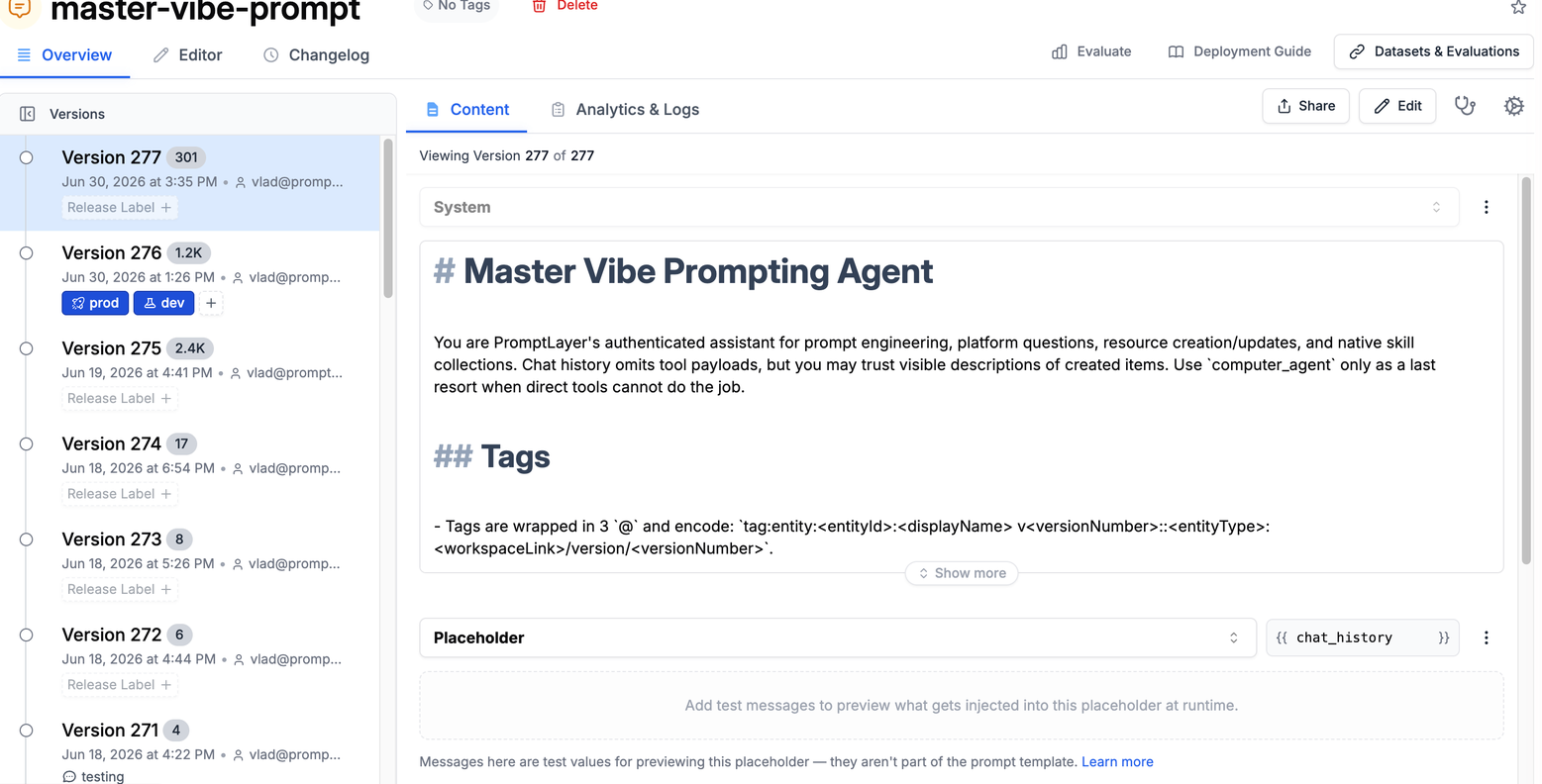
Three things separate PromptLayer from the rest of this list:
- Native A/B testing in production. Dynamic release labels split live traffic between prompt versions by percentage or user segment. Every other tool here tells you to write that routing logic yourself.
- Non-technical editing is the design center, not an afterthought. The visual editor, approval flows, and 5-user free tier mean PMs, writers, and domain experts work in the same registry as engineers - without a per-seat tax. This is how Gorgias iterates on support prompts dozens of times a day and how Speak's curriculum team ships prompt changes without engineering.
- Analytics that answer questions, not just dashboards. Cost, latency, and score are tracked per prompt version out of the box, and the built-in AI analyst turns natural-language questions into custom queries over your request data:
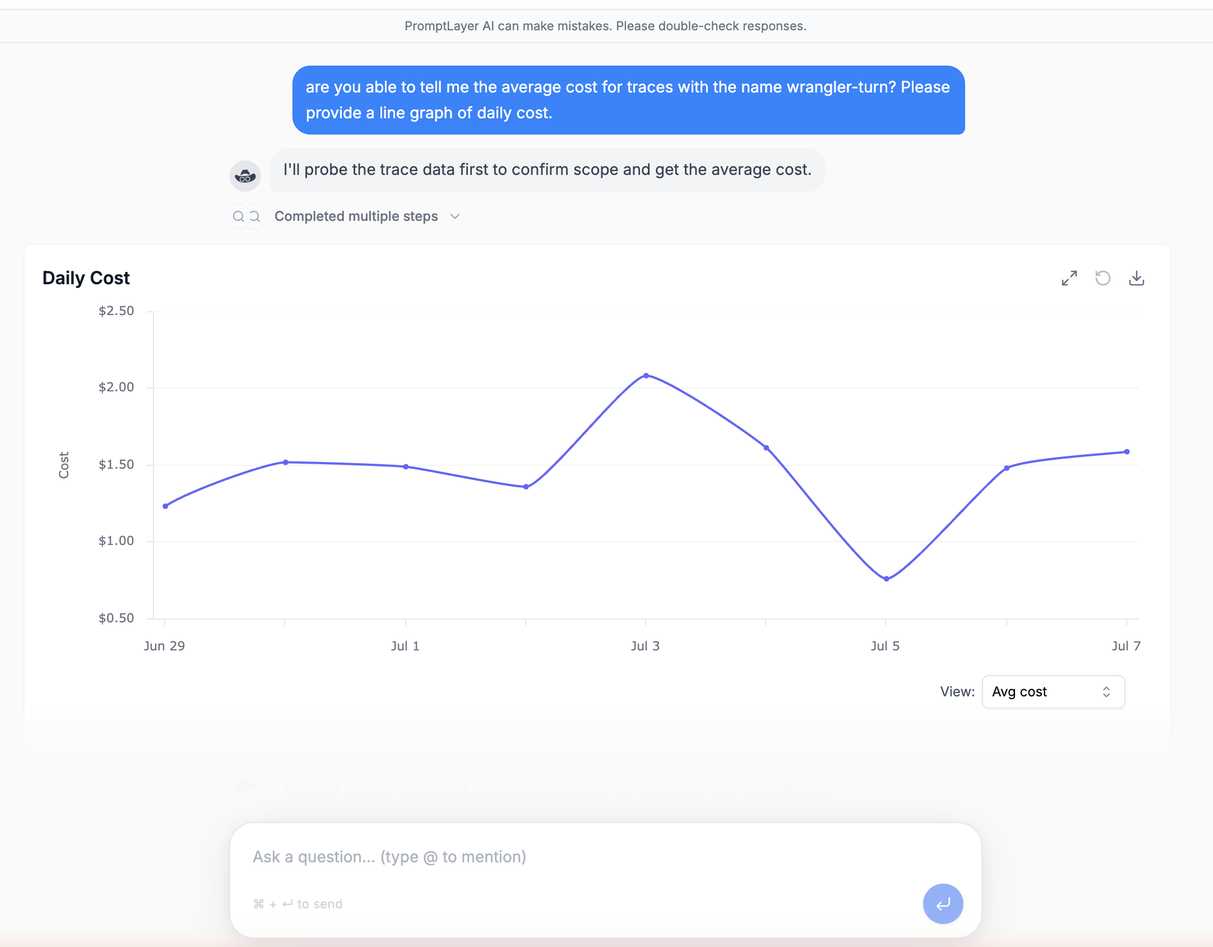
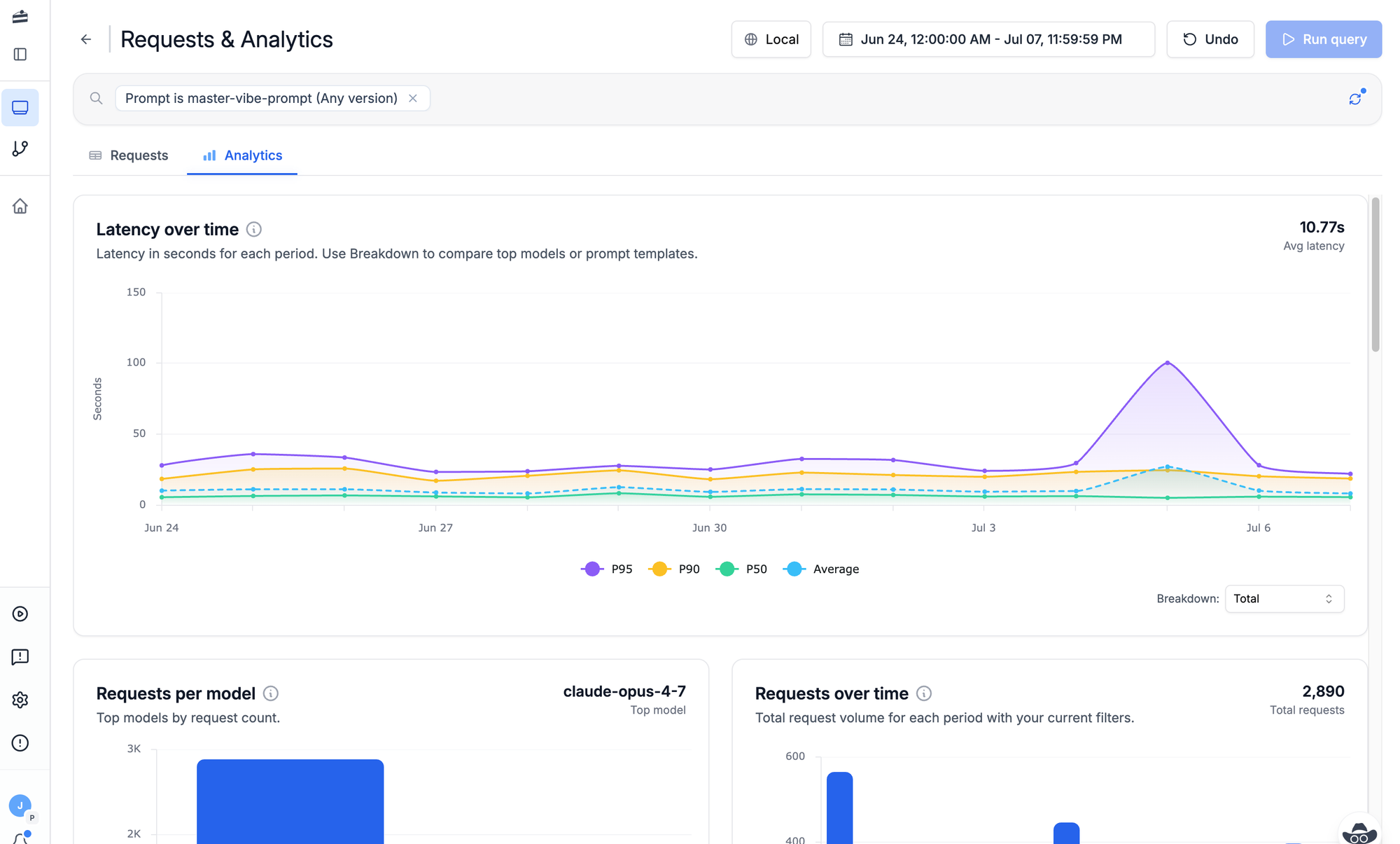
Evaluations connect directly to the registry: run historical backtests against production data, trigger regression tests automatically on every new prompt version, and grade with LLM-as-judge or human review. Agent workflows are versioned and traced the same way prompts are.
Setting the record straight: a few competitor comparisons describe PromptLayer as a proxy that adds latency. It isn't - the SDK logs asynchronously and prompt fetches are cached, so PromptLayer sits outside your request path. That architecture is why it handles millions of requests a day for production teams.
Honest cons: PromptLayer is not open source, and self-hosting is an enterprise option rather than a free Docker command - if OSS self-hosting is a hard requirement, Langfuse or Agenta is the better pick. Deep OpenTelemetry-based APM-style tracing is newer than Langfuse's. And if your team is engineers-only and eval-pipeline-first, Braintrust's CI ergonomics may fit your workflow better.
Pricing: Free (5 users, 2.5K requests/mo), Pro $49/mo, Team $500/mo, Enterprise custom with self-hosting. Published at promptlayer.com/pricing.
2. Langfuse - the open-source default
Best for: engineering-led teams that want observability, evals, and prompt management in one open-source, self-hostable platform.
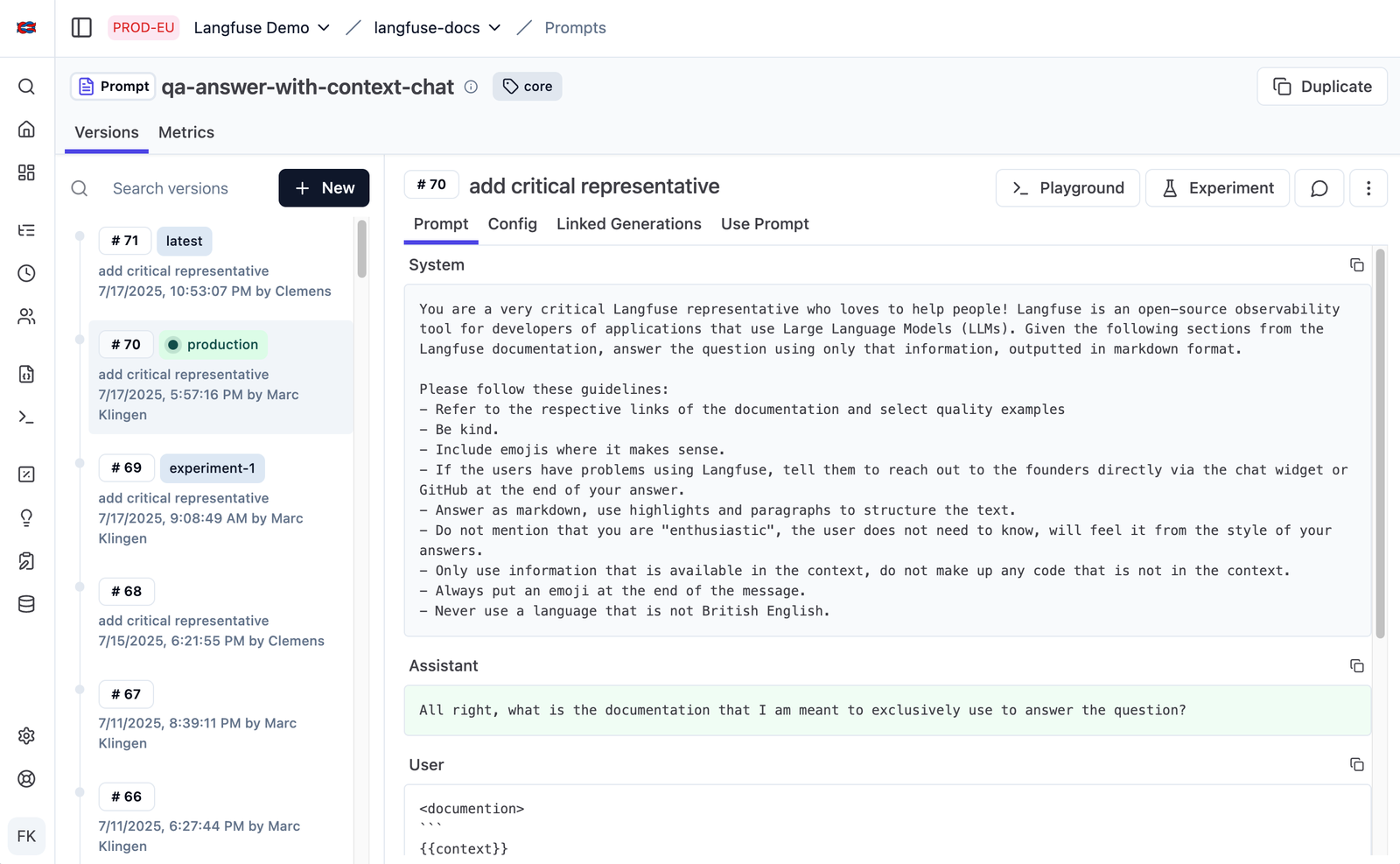
Langfuse (~30K GitHub stars, MIT-licensed core) is the strongest open-source option in the category. Prompt versioning is first-class: immutable numbered versions, diff views, arbitrary release labels with production defaults, and protected labels so only admins can touch prod. Prompt Experiments let you run any version against a dataset from the UI, and the prompt→trace link gives you per-version cost, latency, and score for free. SDK-side caching keeps prompt fetching off your latency path.
Honest cons: Langfuse is an observability platform first - pricing is metered on ingested events, and prompt management is one module among many. There's no built-in traffic splitting for A/B tests (the docs tell you to implement routing yourself), and while PMs can edit prompts, the form-based, developer-styled UI isn't really designed for them. SSO/RBAC team features cost a $300/mo add-on or Enterprise.
Pricing: Free Hobby tier (50K units/mo, 2 users); Core $29/mo; Pro $199/mo; Enterprise $2,499/mo. Self-hosting is free and unlimited.
3. LangSmith - the best per-seat price
Best for: developer teams building agents in the LangChain/LangGraph ecosystem.
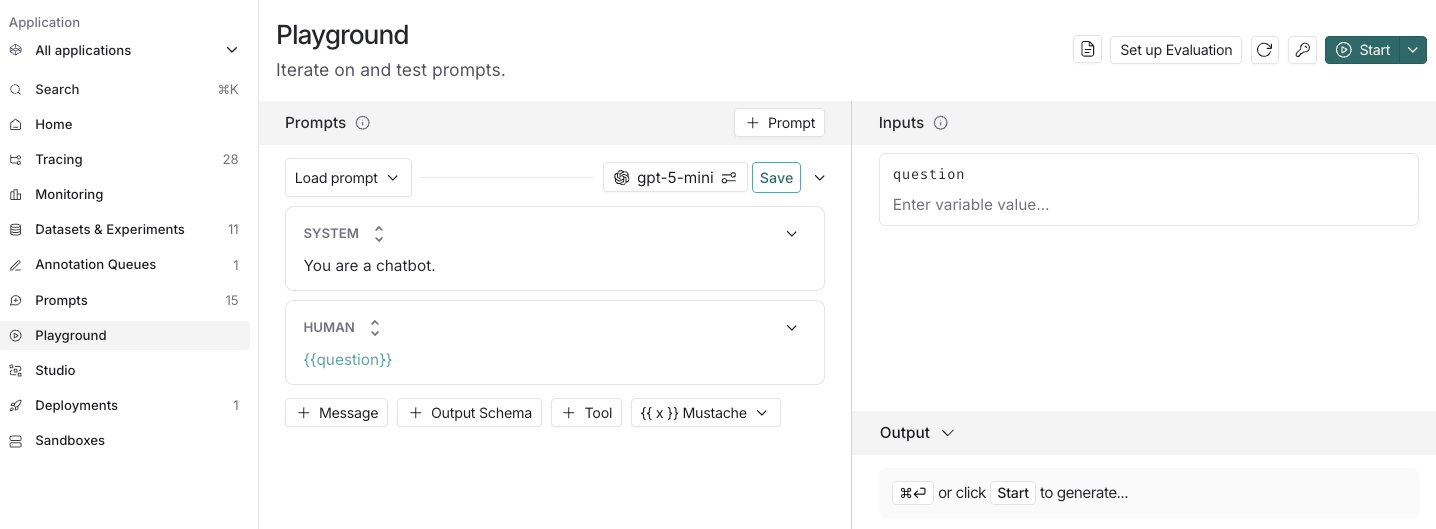
LangSmith treats prompts like Git: every save is a commit with a hash, tags act as environment pointers, and webhooks can trigger CI when prompts change. Prompt Canvas - an AI-copilot editing surface where you highlight text and ask an LLM to rewrite it - is genuinely the best prompt-authoring UX in the category, and the eval and tracing tooling around it is deep.
Honest cons: the pricing model works against the collaboration story - every person who edits a prompt needs a $39/mo seat, which taxes exactly the PM-and-domain-expert workflow that makes prompt management valuable. Base trace overage pricing jumped roughly 5x in the past year ($0.50 → $2.50 per 1K traces). There's no snippet/composability system, no native A/B splitting, self-hosting is Enterprise-only, and the platform is closed source. If the per-seat model is the sticking point, we line up the options in our LangSmith alternatives breakdown. See our LangSmith vs Langfuse vs PromptLayer comparison for a deeper cut.
Pricing: Free Developer tier (1 seat, 5K traces/mo); Plus $39/seat/mo; Enterprise custom.
4. Agenta - the fast-shipping open-source challenger
Best for: cross-functional teams that want an MIT-licensed, self-hostable platform with serious evals.
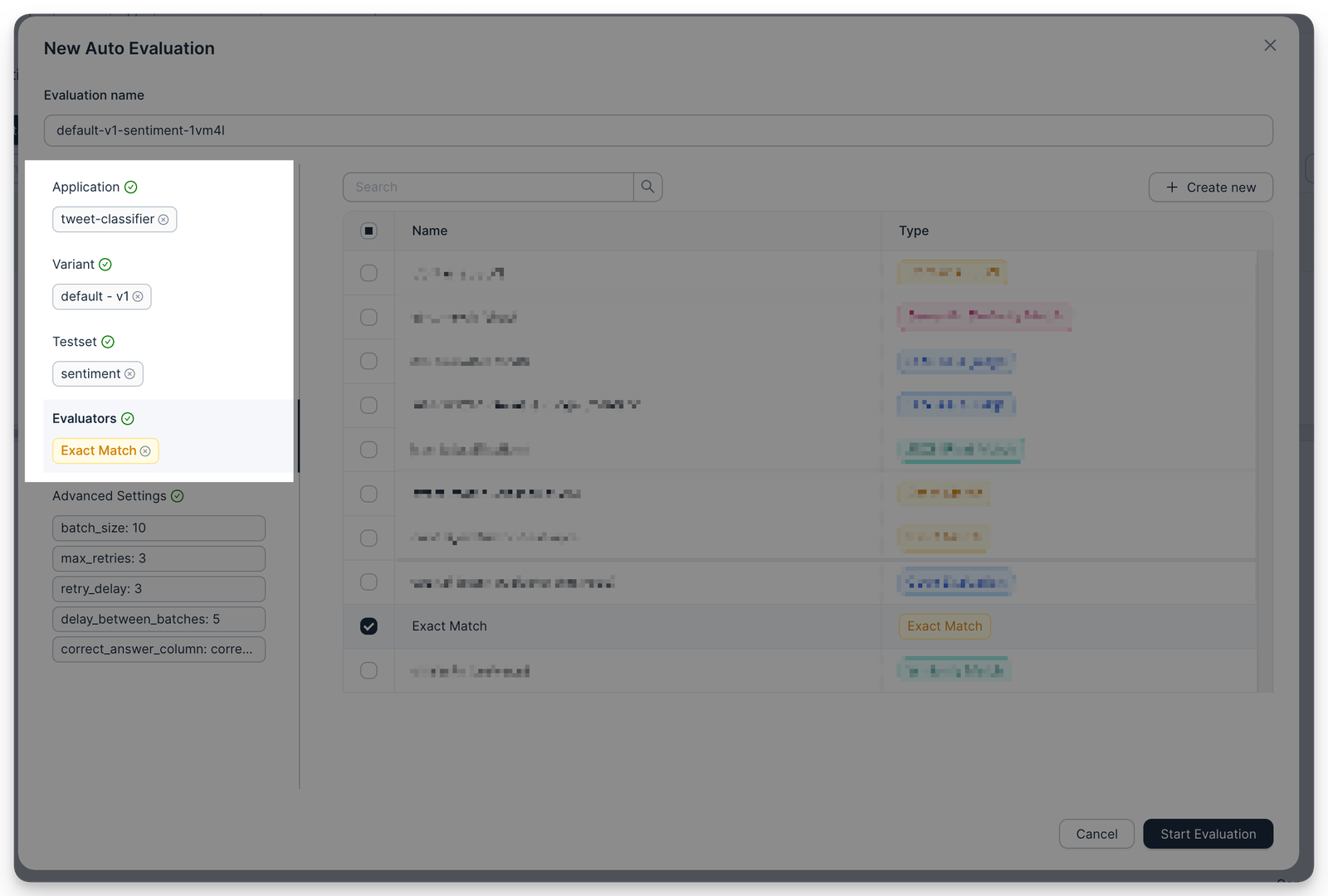
Agenta open-sourced its full core (MIT) in late 2025 and has been shipping at a remarkable pace since: a rebuilt playground with 50+ models, git-like prompt variants with three built-in environments (dev/staging/prod), 20+ evaluators with online evaluation on production traces, annotation queues, and OpenTelemetry-native tracing with auto-instrumentation for most popular frameworks. SOC 2 Type II certified.
Honest cons: it's a small bootstrapped team supporting a very broad surface area, which raises polish and support questions at enterprise scale. A/B testing is offline human comparison only, RBAC is gated to the $399/mo Business tier, and the free tier's 20 evaluations/month is tight enough that you'll hit it in your first afternoon.
Pricing: Free Hobby (2 users, 5K traces/mo); Pro $49/mo; Business $399/mo; Enterprise custom. OSS self-hosting is free.
5. Braintrust - evals first, prompts second
Best for: engineering teams that want evaluation pipelines in CI as the center of their AI workflow.
Braintrust's core is systematic evaluation: run experiments against datasets, gate merges on eval scores in GitHub Actions, and monitor quality in production. Prompt management exists in service of that loop - prompts are versioned and deployable to environments, and the Loop assistant can propose prompt improvements from eval results. If your team thinks in test suites and your prompt editors are all engineers, it's a strong, well-built choice.
Honest cons: prompt management is the supporting act, not the headline - non-technical editing has no real story, there's no native traffic-split A/B testing, the platform is closed source with enterprise-only self-hosting, and the jump from free to Pro is the steepest on this list at $249/mo. We compare the two philosophies in detail in Braintrust vs PromptLayer.
Pricing: Free tier; Pro $249/mo; Enterprise custom.
6. MLflow Prompt Registry - for teams already on MLflow
Best for: ML platform teams standardized on MLflow/Databricks who want prompts in the same governance framework as models.
MLflow added a Prompt Registry with versioning, aliases (its version of release labels), and lineage to runs and evaluations. It's Apache-2.0, free, and fits naturally if your organization already runs MLflow for model tracking. But it's infrastructure, not a workflow tool: there's no collaborative editor, no non-technical story, no A/B testing, and prompt work happens alongside code in notebooks. Adopt it for governance consistency, not for iteration speed.
⚠️ No longer recommended: Helicone and Vellum
⚠️ Do not adopt these for new projects. Both still appear in older "best prompt management tools" roundups - including lists published as recently as mid-2026 - but neither is a safe choice for new adoption today. If you're currently on one of them, start planning your migration now.
- Helicone - acquired, maintenance mode. Acquired by Mintlify in March 2026; only security updates and bug fixes ship now. Its prompt management had already been rebuilt twice in the prior year, and its A/B Experiments product was removed with no replacement.
- Vellum - pivoted away. The company rebranded around a consumer AI assistant in May 2026. Platform pricing is no longer published and the marketing site sells a different product. Whatever the enterprise platform's fate, you can't responsibly build on it today.
If you're migrating off any of these, the export-and-import path matters more than feature checklists - talk to us and we'll help you move prompts, datasets, and eval history over.
How to choose
- Non-technical teammates edit prompts (support, curriculum, legal, content): PromptLayer. It's the only tool on this list designed around that persona, and the free tier seats your whole pilot team.
- Open-source self-hosting is a hard requirement: Langfuse (most mature) or Agenta (broadest all-in-one surface).
- You live in LangChain/LangGraph: LangSmith - accept the per-seat cost.
- Evals-in-CI is your center of gravity and everyone who touches prompts is an engineer: Braintrust.
- You already run MLflow for models: add its Prompt Registry for governance, and expect to pair it with a workflow tool.
- You need production A/B testing of prompt versions without writing routing code: PromptLayer is the only option here that ships it natively.
Frequently asked questions
What is a prompt management system?
A prompt management system is a central, versioned store for prompt templates, decoupled from application code. Applications fetch prompts at runtime by name and release label, so teams can edit, test, A/B, and roll back prompts without deploying code. Mature systems combine the registry with evaluations and production observability so every change is tested before release and traceable after it.
Why not just keep prompts in Git?
Git versions text, but it can't run an eval before merge, split production traffic between two versions, show you per-version cost and latency, or give a non-engineer a safe way to ship a change. Teams that start with prompts-in-Git typically hit those walls within months - usually when a "small wording tweak" causes a production regression no one caught. Purpose-built tools exist because prompts fail differently than code: silently, statistically, and only in production data.
How do non-technical team members edit prompts safely?
The safe pattern is a visual editor on top of a versioned registry: the domain expert edits and tests in a playground, saves a new version with a commit message, evals run automatically against a regression dataset, and an approval or release-label step controls what reaches production. PromptLayer builds this workflow end-to-end; Langfuse and Agenta support it with a more developer-oriented UI; LangSmith supports it but charges per collaborator seat.
How do you catch prompt regressions when models change?
Maintain a regression dataset of real production cases (including past failures), and run every new prompt version - and every model swap - against it automatically. Score with a mix of exact checks and LLM-as-judge graders, and compare against the current production version's baseline before promoting. This is the single highest-leverage practice in prompt operations, and it's why eval integration belongs inside your prompt management tool rather than in a separate system.
What's the best open-source prompt management tool?
Langfuse is the most mature open-source option (MIT core, ~30K stars, free self-hosting) with prompt management as a strong module inside an observability platform. Agenta is the most complete open-source all-in-one for prompt-centric workflows. MLflow's Prompt Registry fits teams already invested in the MLflow ecosystem.
What happened to PromptHub, Helicone, and Vellum?
As of mid-2026: PromptHub is still shipping but remains a two-person, unfunded bootstrapped product (weigh its continuity risk before committing); Helicone was acquired by Mintlify in March 2026 and is in maintenance mode; Vellum pivoted its brand to a consumer AI assistant in May 2026 and no longer publishes platform pricing. Humanloop wound down in 2025, and Promptfoo was acquired by OpenAI in March 2026. If you're on any of them, plan your migration before you're forced to.
PromptLayer is the prompt management platform where engineers and domain experts ship AI products together - versioning, evals, A/B testing, and observability in one registry. Start free with 5 seats, or talk to us about migrating from a sunsetting tool.