


Use-Case Driven Evaluations
Evaluations that empower
Automatic Triggering
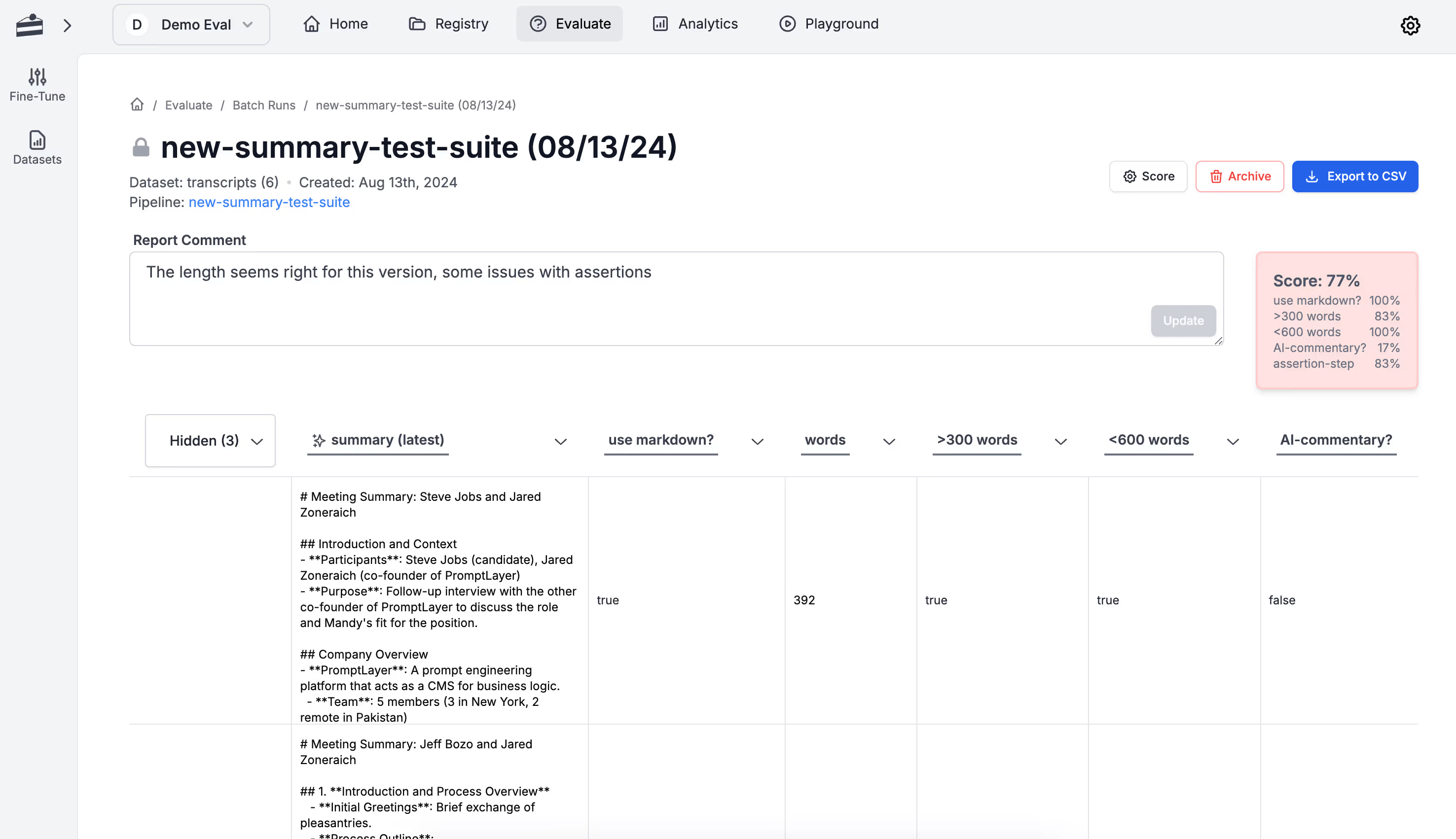
Automatically trigger evaluations on each new prompt version, via the API, or ad-hoc on the UI.
Simple Backtests
Connect evaluation pipelines to production history to run historical backtests.
Model Comparison
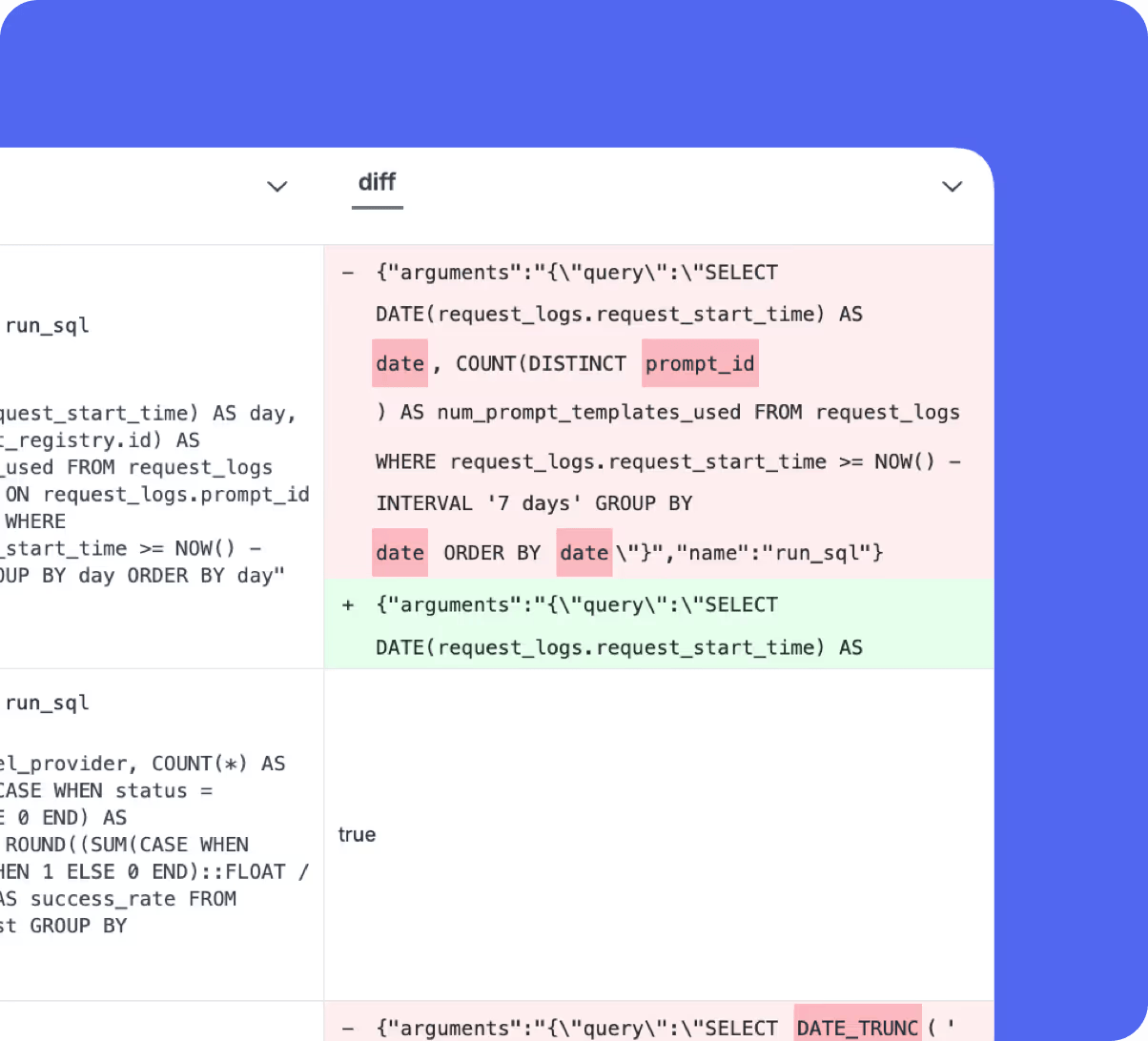
Compare and contrast different models in a side-by-side view, easily identifying the best performer.
Flexible Evaluation Columns
Choose from over 20 column types, from basic comparisons to LLM assertions and custom webhooks.
Comprehensive Scorecards
Create score cards with multiple metrics to fit your evaluation needs.
Easy yet Powerful
Simple to start, flexible for any use case or team skill level.
Evaluation System
Increase your LLM application performance
Create evaluations to understand how your models are performing. Judge both qualitative and quantitative aspects of performance. Our evaluation system is designed to be flexible for any use case or team skill level.
Maximum Coverage
Whether you want to test for hallucinations or classification, our evaluation system can handle it.
Extreme Flexibility
We provide both out of the box evaluations and tools to create your own.
Easy to Understand
Our evaluation system is built to satisfy both ML experts and non-technical users.
Seamless Integration
Connect your evaluations to your prompts and datasets to set up an easy CI/CD process. Think Github Actions.
Guide
LLM evaluation, explained
What is LLM evaluation?
LLM evaluation is the practice of systematically measuring the quality of a language model's output so you can ship changes with confidence instead of vibes. Every time you edit a prompt, swap a model, or tweak a retrieval step, you need to know whether the change made things better or worse. That measurement — run over a representative dataset and tied to a specific prompt version — is what separates a reliable AI product from one that quietly regresses in production.
What makes LLM evaluation genuinely hard is that language models are non-deterministic and there is rarely a single ground-truth answer. Traditional software has deterministic outputs you can assert against; a summarization prompt or a support agent can produce dozens of valid responses that differ in wording, length, and tone. The same input can yield different outputs across runs. So "correct" becomes a spectrum — is the answer faithful to the source, relevant to the question, safe, and appropriately concise? — and your evaluation has to capture that spectrum rather than a single pass/fail bit. Good prompt management and disciplined LLM evals go hand in hand: you version the prompt, then you measure each version against the same tests.
How to evaluate LLMs: code checks, human review, and LLM-as-a-judge
There are three complementary methods for evaluating LLM output, and mature teams use all three rather than betting on one. In PromptLayer these run as columns in a single evaluation table, so you see every score for a given output side by side.
Deterministic code checks. These are fast, free, and perfectly repeatable: exact-match assertions, regex patterns, JSON-schema validation, "does the output contain X," latency ceilings, and cost thresholds. Use them wherever correctness is objective — structured extraction, classification labels, valid tool arguments, or format compliance. They should be your first line of defense because they never disagree with themselves and cost nothing to run at scale.
Human review and grading. For subjective quality — tone, helpfulness, brand voice, nuanced factuality — a human grader remains the gold standard. Human review is slow and doesn't scale to millions of rows, but it's how you build a trusted labeled set and, critically, how you validate that your automated scorers actually agree with human judgment.
LLM-as-a-judge. This is how you automate LLM output quality testing for the subjective cases that code can't check. An "AI judge" is a second model prompted with the evaluation criterion, the input, and the generated output; it returns a numeric score, a binary verdict, or a preference between two candidates. LLM-as-a-judge is scalable enough to grade thousands of outputs yet flexible enough to assess meaning, grounding, and style. It has known failure modes — judges can favor longer or more fluent answers regardless of correctness — so treat the judge prompt as a first-class artifact you version and calibrate against human labels. We published our real production judge prompt, refined over 18 versions, in the ultimate guide to LLM-as-a-judge. Pairwise comparison (which of two versions is better) is often more reliable than absolute scoring when you're choosing between prompt candidates.
LLM evaluation metrics
Whichever method you use, you need to decide what to measure. The right LLM evaluation metrics depend on your use case, but a handful recur across almost every application:
- Accuracy / correctness — does the output match the expected answer or label? Best measured with code checks against a reference.
- Groundedness / faithfulness — for RAG, are the claims supported by the retrieved context rather than hallucinated? Typically scored by an LLM judge with the source documents in view.
- Answer relevance — does the response actually address the user's question, or does it drift?
- Toxicity, bias, and safety — does the output stay within policy? Often a mix of classifiers and judge prompts.
- Latency — response time, which you can assert against a hard ceiling.
- Cost — tokens and dollars per request, which belong in the same eval so a "better" answer that triples cost doesn't sneak through.
The practical move is to combine a few objective metrics (accuracy, latency, cost) with one or two judge-scored qualitative metrics (faithfulness, relevance), then track all of them per prompt version over time. Metrics you don't watch are metrics that regress silently — pairing evals with observability on live traffic closes that loop.
Evaluating AI agents
Agent evaluation is harder than scoring a single LLM call because an agent produces a trajectory — a sequence of reasoning steps, tool invocations, and state transitions — not just a final string. A system can arrive at the right final answer through the wrong path, which is a false positive and a real production risk. So agent evals have to grade both the destination and the route.
The metrics that matter for agents include task success (did it achieve the goal?), tool-call accuracy (did it call the correct tools with the correct arguments?), trajectory quality (was the sequence of steps coherent and efficient?), and grounding (are the agent's claims supported by tool outputs rather than invented?). For multi-turn agents you evaluate task completion over the entire conversation history while still checking individual tool calls turn by turn. Because agents are non-deterministic, reliability metrics like pass^k — the probability of succeeding across k independent attempts — matter as much as a single run. Running these as backtests over historical agent runs, tied to the exact agent version, is the only way to catch trajectory regressions before users do.
Leading LLM evaluation frameworks & tools compared
The best LLM evaluation framework is the one that fits how your team actually works — some teams live in a Python test suite and CI, others need product managers and domain experts grading outputs in a shared UI, and most serious teams need both. The market splits roughly into code-first open-source frameworks (DeepEval, OpenAI Evals, Promptfoo), open-source observability platforms with eval features (Langfuse), and commercial eval-and-observability platforms (Braintrust, LangSmith, PromptLayer). The table below compares the leading LLM evaluation tools on the dimensions that decide day-to-day usability: which evaluation methods they unify, whether they run programmatically in CI, whether they're open source, and who they fit best. PromptLayer's differentiator is that code checks, human review, and LLM-as-a-judge run as columns in one evaluation table, with every run tied to a specific prompt version and dataset.
| Tool | Approach | Code + human + AI-judge in one | CI / programmatic | Open source | Best fit |
|---|---|---|---|---|---|
| PromptLayer | Eval tables tied to prompt versions + observability | Yes — all three as columns in one table | Yes — Python/CLI evals for CI/CD (run on your own infra) | No (commercial) | Teams wanting engineers and non-engineers evaluating in one place, tied to versioned prompts |
| DeepEval | Pytest-style LLM eval framework, 50+ metrics | Code + AI-judge; human review via its Confident AI platform | Yes — pytest-style assertions | Yes (open source) | Python engineers who want unit-test-style evals locally |
| OpenAI Evals | Framework + open registry of benchmarks | Primarily code + model-graded evals | Yes — CLI/config driven | Yes (open source) | Benchmarking models against standardized or custom evals |
| Braintrust | Eval-first observability platform | Code + AI-judge scorers + review UI | Yes — SDK/proxy | No (proprietary) | Teams wanting a hosted eval + tracing platform |
| LangSmith | Observability + evals, LangChain-centric | Built-in evaluators + judge templates + annotation | Yes — SDK | No (proprietary; self-host on Enterprise) | Teams deep in the LangChain/LangGraph stack |
| Langfuse | Open-source observability with eval primitives | Scoring, annotation queues, LLM-as-a-judge (assemble your own) | Yes — SDKs + OTel | Yes (open source, self-hostable) | Teams wanting self-hosted, framework-agnostic tracing + evals |
| Promptfoo | Declarative YAML eval + red-teaming CLI | Code assertions + LLM-graded; no built-in human UI | Yes — CLI, native CI/CD | Yes (open source, MIT) | Engineers wanting config-driven eval and security red-teaming in CI |
How to choose an LLM evaluation tool
Cut through the feature lists with a short checklist mapped to what actually determines whether evals become part of your workflow or get abandoned:
- Does it unify code + human + AI-judge? If a tool only does one, you'll end up stitching three systems together. Look for deterministic checks, human grading, and LLM-as-a-judge scoring side by side on the same outputs.
- Regression tests over real datasets. You want batch eval runs and backtests over historical requests, not just one-off spot checks, so you can prove a new prompt version beats the old one before shipping.
- CI / programmatic access. Evals belong in your pipeline. Confirm there's an SDK or CLI so a failing eval can block a bad deploy automatically.
- Tied to prompt versions. Every eval result should point back to the exact prompt version and dataset that produced it — otherwise you can't trust the history or reproduce a score.
- Linked to observability. The strongest setups connect offline evals to live production monitoring, so failures you catch in traffic become new eval cases.
- Usable by engineers and domain experts. Prompt evaluation is a team sport; a visual eval table plus an API means both audiences contribute.
Score your shortlist against those six criteria and the right tool for your team usually becomes obvious. If you want code checks, human review, and an AI judge in one versioned table wired to your production logs, that's exactly what PromptLayer's evaluations are built for.
Frequently asked questions
If you still have questions feel free to contact us at sales@promptlayer.com